


LOCATION: WÖNZIMER, LOS ANGELES, CALIFORNIA
7TH JUNE - 16TH JUNE
Open Wednesday - Sunday, 12noon - 7pm
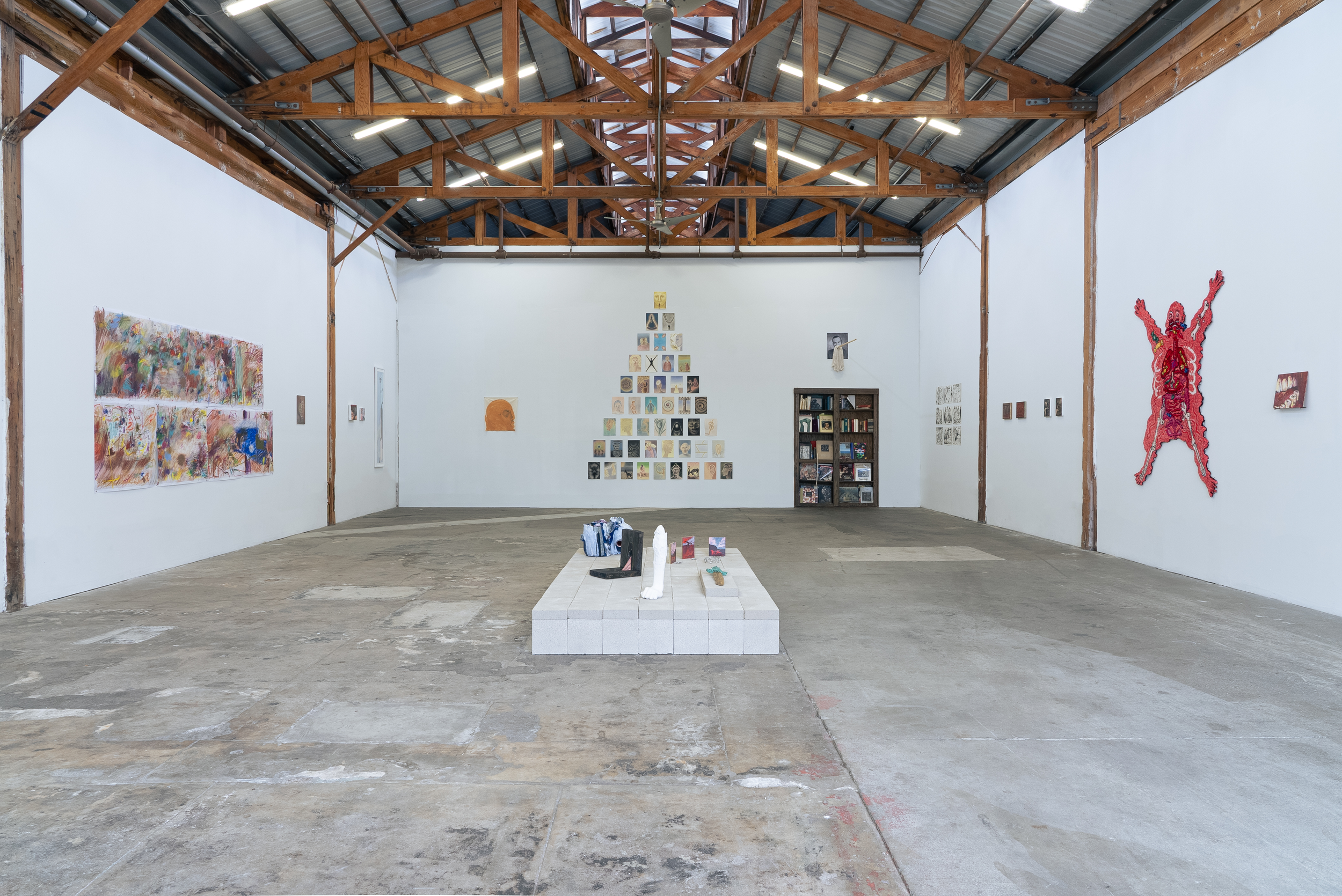
A ‘TASTE’ of OHSH Projects in Los Angeles is a taste of the British art scene, a cross-section of the artists the project space has exhibited since their foundation three years ago.
In 2021, the idea for OHSH Projects was conceived in the wake of the pandemic, in response to the lack of opportunities for contemporary artists and the proliferation of empty shopfronts across London. This being a direct result of Brexit, a long-term conservative government, as well as the pandemic. After the pandemic Britain entered a recession and a bleak period, much like Thatcher’s Britain in the 1980s.
However, times of hardship tend to produce the most exciting and engaging art, OHSH Projects is a reflection of a new wave of art being made in Britain. By artists who are from the UK and who have come to London and the UK from across the globe, searching for the means to continue making and exhibiting their work, despite socioeconomic hardship.
‘TASTE’ will include work by twenty-five OHSH exhibitors alongside five Wönzimer exhibitors, each of whom present a unique vision at differing stages of their careers. The hardships of Britain are echoed in the United States – like Brexit, their politics looking inward, creating division and austerity. Yet, the art exhibited by Wönzimer echoes a sense of playful hope through a critical lens.


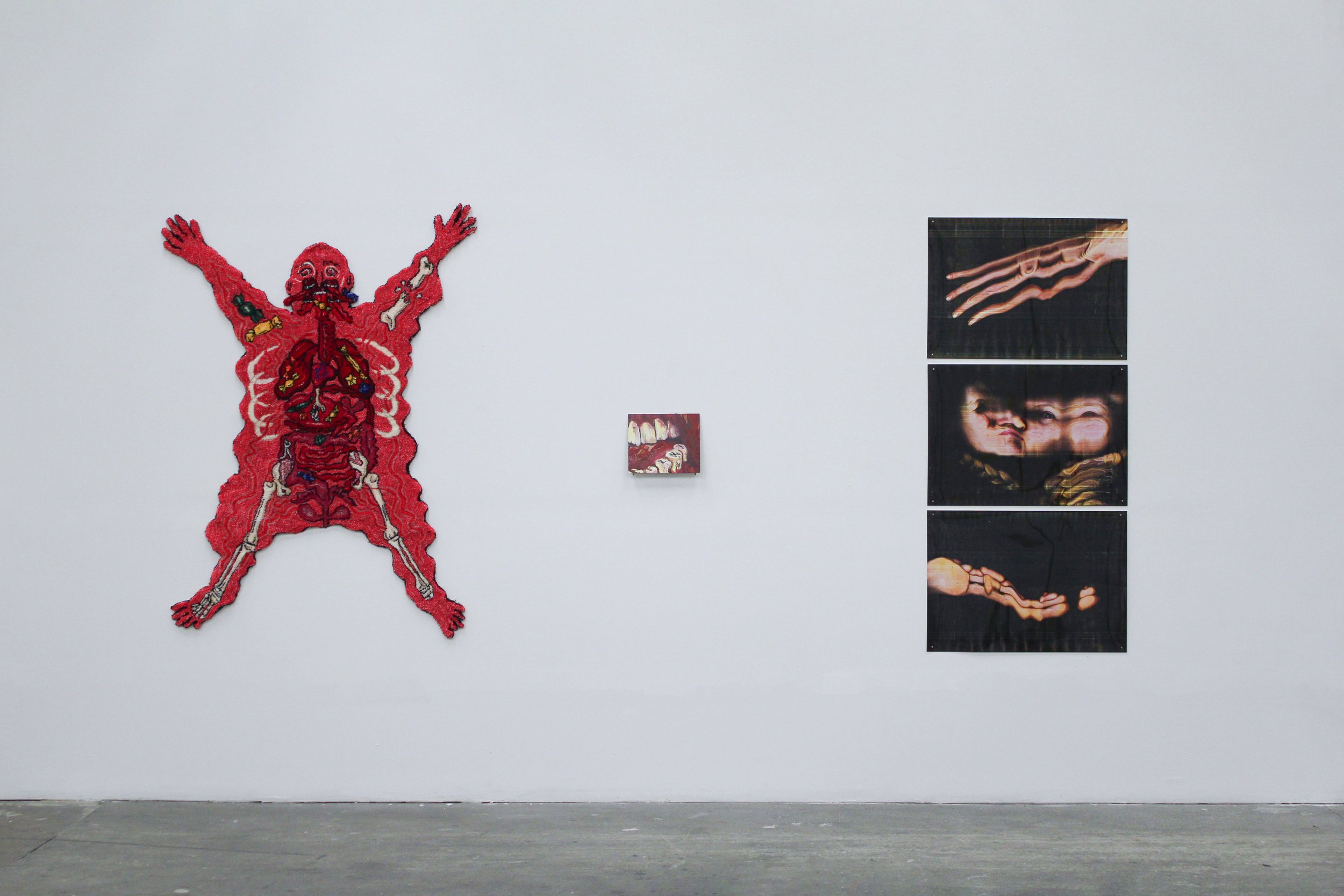



Entering the gallery, you are greeted by three OHSH exhibitors, Hester Finch, Justin Mortimer and Jamie John Davies, all of whom delve into the intersections of reality, abstraction, and human psychology. Finch combines traditional and digital media to explore how technology impacts personal relationships, creating layered, conceptually rich works. Mortimer blends figuration and abstraction to explore themes of beauty and horror, often playing with the relationship between evidence and interpretation. Davies uses medieval imagery and contemporary references to examine the absurdity and rituals of human behaviour, creating a caricature of our primal and irrational selves.
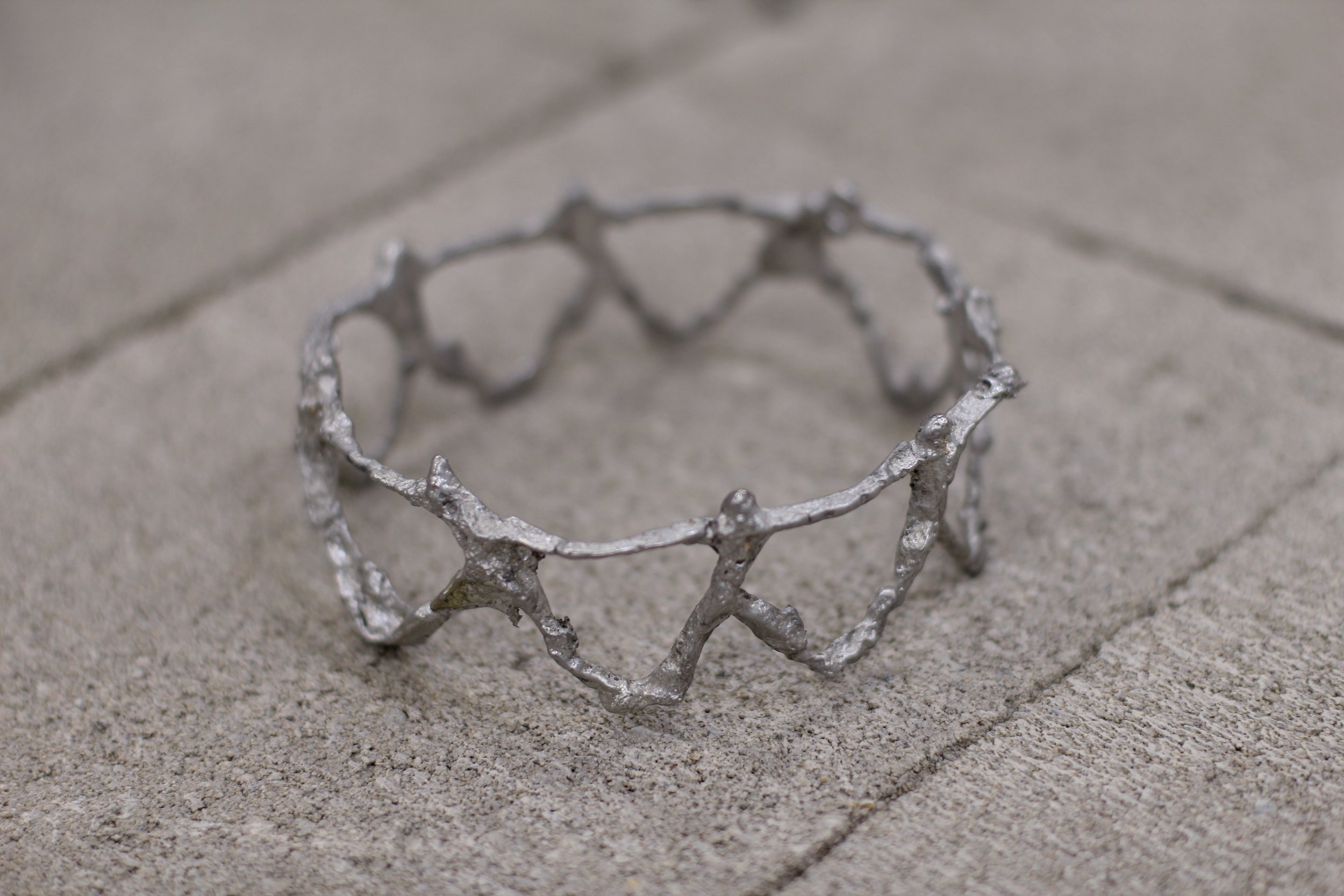
Moving around the gallery, we have brought works by Haydn Albrow, Lucile Haefflinger and Rosie Gibbens together, who explore the relationship between the human body, personal experiences, and broader societal themes. Albrow addresses the conscious and unconscious mind, using physical materials to articulate the ineffable nature of dreams and memories. Haefflinger expresses the alienation of experiencing one's body in relation to the natural world, using painting and sculpture to explore this connection. Whilst Gibbens uses her body in performances and sculptures to critique gender performativity, sexual politics, and consumer culture, often employing absurd humour.
Hynek Martinec, Magda Blasinska and Lisa Ivory are united by their engagement with historical and mythological themes, reinterpreted through contemporary lenses. Lisa Ivory explores mythical creatures and classical narratives, creating fantastical worlds that delve into the concept of otherness. Blasinska uses sensory experiences and folk heritage to create works that reflect her fragmented memories of Soviet and Post-Soviet Poland, and Martinec, who was brought up in the Czech Republic, creates hyper-realistic portraits that link past and present, drawing from Old Masters and exploring life and death.
At the end of the gallery, Dale Adcock’s monumental ‘R/V Pyramid’ drawing installation embodies the space with the artists investigations of his own psychology and imagination. Each drawing is the result of a daily practice, allowing the artist to access his subconscious to draw out his understanding of life and human history. Influenced by mythology and appearing as ancient relics, Dale’s works seem to defy categorisation or a particular moment in time. Alongside Adcock, Cheyann Washington and Jonny Briggs likewise explore the self in their practice. Briggs uses photography to question familial constructs, and Washington reflects on human behaviour and nature in her paintings. Despite differing mediums and approaches, they share a common theme of introspection and self-discovery.
A profound engagement with the medium of painting bonds Moussa David Saleh, Jonathan Tignor, and Joshua AM Ross, each approaching their practice from distinct conceptual and thematic angles. Saleh, with his playful yet subversive style, delves into sombre subjects like time, death, and shame, while also exploring the dichotomy between human formality and innate ferality. Tignor, on the other hand, focuses on narrative and tension in his paintings, weaving stories around the concept of tension itself and inviting viewers to contemplate the strangeness and precarity of his imagery. Meanwhile, Ross's practice takes a phenomenological approach, investigating the organisational structures that shape perception, whether institutional, bodily, or spatial, and employing various materials and media to convey these investigations.
Mark Jackson, known for his experimental and surreal paintings that often blur the lines between reality and imagination, shares a predilection for pushing the boundaries of painting with Jemima Moore. Moore investigates the formal properties of various subjects, such as old master paintings and football team formations, using oil pastels and paint to explore the interplay between source images and new forms. Despite their differing approaches—Jackson's works often elusive and narrative-driven, while Moore's iterative studies dissolve original motifs—they both challenge traditional notions of art and perception.
Rebecca Byrne and Lucien Dante Lazar both explore the intersection of psychology and spirituality in their art. Byrne creates immersive landscapes on paper and canvas, while Lazar works across mediums like painting, sculpture, and music to facilitate healing and reflection. Both invite viewers to contemplate the depths of human consciousness and the relationship between inner and outer worlds.
Jon Baker's room-size macro camera captures highly detailed photographic images that reference the human body, puppets, and children's art, reflecting his fascination with the future of the human body and the role of technology in enhancing it. In contrast, Alaïa Parhizi's Imperfectionism movement celebrates the accidental nature of artistic creation, encouraging artists to embrace spontaneity and imperfections in their work. Despite their divergent approaches, both artists challenge conventional notions of artistry and invite viewers to explore the complexities of human existence through their respective mediums.
Charlie Chesterman, Henry Glover, and Miroslav Pomichal explore human desires, emotions, and historical contexts. Chesterman critiques themes of greed, hedonism, and waste, creating paintings that provoke introspection and challenge viewers. Glover focuses on the interplay between materials and raw emotions, creating imagined landscapes and sculptures that explore personal and historical themes. Pomichal uses a sculptural treatment of the picture plane to depict emblematic symbols and scenes of conflict, addressing modern life's tragedies and the spiritual side of humanity. Whilst alongside these artists Samantha Fellows is concerned with capturing moments; the sense of a fleeting experience or memory, held indelibly in the swirling application of paint over a slick surface.
In the centre of the gallery Hugo Winder-Lind, Joshua Goode, Guy Haddon Grant, Alexander Gilmour and Gary Brewer have been brought together on a large concrete plinth evoking a stage or a tournament arena. Their diverse practices engage with nature, memory, and community. Winder-Lind and Brewer immerse themselves in the natural world, Winder-Lind through landscape exploration and Brewer through organic forms. Gilmour and Haddon Grant delve into the figurative realm, Gilmour weaving memory and observation, while Haddon Grant navigates archetypal symbols. Goode's historical manipulations intersect with Winder-Lind's fascination with natural cycles and Haddon Grant's exploration of collective myths.
The thirty artists exhibited in ‘TASTE’ probe the complexities of human existence, from unhinged narratives and the contemplation of otherness to the subconscious landscape of our dreams, each work provoking contemplation of the human condition, encouraging us to reflect on our lived experience, across continents.
THE ARTISTS:

-
(b.1980, United Kingdom) lives and works in London. Studied BA (Hons) Fine Art Painting at Wimbledon School of Art (2003). MA in Fine art from Chelsea College of Art & Design (2005). Adcock has exhibited at TJ Bolting, Transition Gallery, Saatchi Gallery, Beers, ID Gallery, Hong Kong, and had a solo exhibition at OHSH Projects in 2022. He was nominated for the John Moores Painting Prize in 2023. Dale’s monumental paintings and hypnagogic drawings draw upon the artists investigations of his own psychology and imagination. A daily practice of drawing allows the artist to access his subconscious to draw out his understanding of life and human history. Influenced by mythology and appearing as ancient relics, Dale’s works seem to defy categorisation or a particular moment in time.

-
(b. 1993, United Kingdom) addresses themes of the conscious and unconscious mind; thinking of our brain as a machine that manipulates and interprets memories, language and dreams into sensical thoughts. In particular their work explores the ways we attempt to share our dreamed experiences and the difficulties we face in conveying their ephemeral sensations and sentiments. There are gaps in our language that cause us to struggle to articulate these unique and deeply personal experiences and the artist tries to use physical materials to create a new form of dialogue for when words fail us. Albrow studied MFA Sculpture at the Slade School of Fine Art (2018-21) and BA (Hons) Fine Art at The Cass – London Metropolitan University (2016).

-
Jon Baker (b.1977) is an artist working with photography and drawing. He makes photographic images using a room-size macro camera. The highly detailed images reference the human body, puppets and children's art. Recent drawing work has included watercolour and ink images that take an X-ray view of the body revealing mechanically enhanced limbs and organs. Jon is interested in the future of the (his) body and the role of technology in enhancing it.

-
(Poland) draws from the fragmented memories of the artist’s post - Soviet upbringing in rural Poland and her day-to-day experience of living in the UK. Primarily a painter, Blasinska builds the world of light and tactile surfaces, utilising humble and physically insubstantial materials such as painting with air and weaving with straw. Her shimmering, immersive installations navigate somewhere between Magical Realism and Arte Povera, creating illusive effect and providing a context to her painting. In parallel to her thatch and hand-woven wheat reed installations, Blasinska’s painting methodically highlights the physical presence of the human hand. The linen supports are stretched and prepared by hand. Rich textures and canvas depths are achieved thanks to slow application of layers of highly pigmented oil paint, elevating the artist's interest in alchemical properties of painting.

-
(b. 1985, London) lives and works in London. In search of lost parts of his childhood, Briggs explores a reality outside of the one he was socialised into by creating new ones using himself and his parents as the main subjects. Briggs uses photography to explore his relationship with deception, the constructed reality of the family, and to question the boundaries between child/adult, self/other, nature/culture, real/fake in attempt to revive the unconditioned self, beyond the family bubble. Although easily assumed to be photoshopped or counterfeit, upon closer inspection the images are often seen to be more real than first expected. Involving staged installations, the cartoonesque and the performative, Briggs looks back to his younger self and attempts to recapture childhood nature through assuming adult eyes.
-
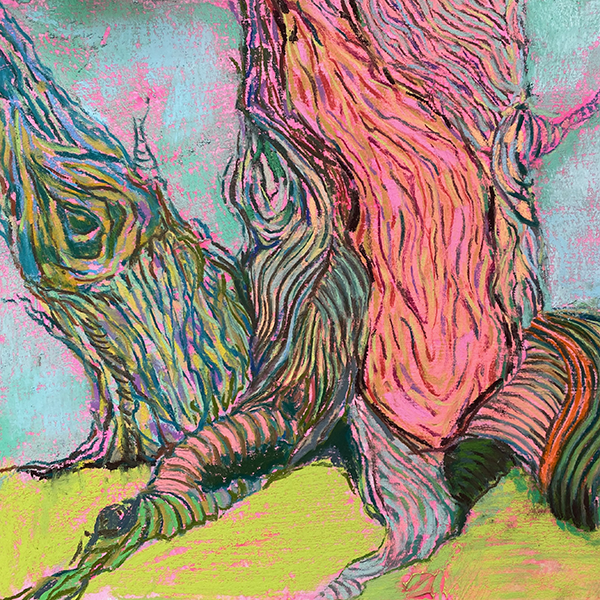
Rebecca Byrne is an American artist living and working in London with a practice based in drawing and painting; she works on canvas and aluminium, as well as 9m long paper which she uses to create immersive site-responsive installations that can be rolled up and reinterpreted in another location. Her interest is in the psychological impact of spaces, both man-made and natural, and she presents strange landscapes that reflect an interior world. Byrne’s uncanny and fantastical landscapes are rooted in fragments of memory, reality and fantasy; her recent work references natural subjects as portraits of time, fragility and struggle. She explores our relationship to nature by referencing images of extinct and existing plant life that never actually co-existed, creating pictures of nature in flux to propose an alternate natural world infused with searing colour. Beginning with a vibrant, textured ground and intuitive gestural marks, Byrne draws, erases and layers repeatedly until the surface becomes a palimpsest of images. She repeats her subject matter, mining the constant state of change in the natural world to explore the parallels she finds in the limitless language of drawing and painting.

-
(b.1996, UK) lives and works in London. Charlie explores through his works the intricate relationship of human desires, shining a critical light on the themes of greed, hedonism, abstinence and waste. The narrative of the work tends to celebrate a subject while simultaneously denouncing it. It’s an ongoing search for a kind of embarrassed result in which they aim to provoke introspection, challenging viewers to question their own impulses and the consequences of their actions. An evolution in the artists practice has been a growing affinity for paintings as reliefs - a hierarchy of layering, but also of excavation. Chesterman envisages a painting as a kind of stage; a lot of the work is created on separate canvases to where they end up, which isn’t dissimilar to a rehearsal. This transition has granted them with the opportunity to implement collage into the work, not solely as an embellishment, but as an option to later reveal hidden layers beneath the surface. The interplay between addition and withdrawal, unveiling and concealing, a process that mirrors the complexity of the themes he seeks to convey. Charlie graduated from Central Saint Martins in 2019 and Leeds College of Art in 2016.

-
(b. 1986, Wales) is a London based painter, whose work explores the human condition, absurdism, ritual and superstition and the uncanny. His most recent works reference crude, contemporary representations of medieval man, often sourcing stock imagery from torture museums and medieval re-enactments to caricature our base, bestial, primitive and irrational selves, exploring the shared, fundamental aspects of the human experience. Recent group exhibitions include ‘Careful The Tale You Tell’, Shipton (2024), ‘The Way of All Flesh’, Delphian Gallery (2024), ‘Disneyland Past-Life’, Grove (2023).

-
Samantha Fellows (b. 1971, USA) is concerned with capturing moments; the sense of a fleeting experience or memory, held indelibly in the swirling application of paint over a slick surface. In the act of painting, she carefully manoeuvres and slides translucent layers of oils over a glossy white ground of enamel, her goal is to disturb the slippery glazes of oily colour until the desired image and accompanying sense of something, is secured. Her focus is to present the souvenir of a sensation.

-
Hester Finch (b. 1981, UK) is a British artist based in London. Her practice plays with the crossover between painting and digital media, often combining printed imagery with traditional analogue mediums such as oil and charcoal. With an interest especially in how our day to day lives are filtered through technology - particularly our relationships be they with lovers, family or friends - she seeks to impart meaning through collaging imagery to create chains of associations, which are laid down upon unorthodox supports such as found domestic fabrics. One aim is to create an environmentally sustainable practice that is loaded conceptually but light physically. Finch is currently studying for her MA Painting at the Royal College of Art and achieved her BA Fine Art from the Ruskin School at Oxford University.

-
Rosie Gibbens (b.1993, UK) makes performances, videos, sculptures and photographs that feature her body. Using absurd humour, she explores gender performativity, sexual politics, consumer desire, labour and the slippery overlaps between these. She often makes sculptures that combine everyday objects with sewn body parts and become props in the performances or films. The mindset behind her work is of someone attempting to participate seamlessly in contemporary life, but not quite managing. Rosie studied ‘Contemporary Art Practice’ at the Royal College of Art (2018) and ‘Performance Design and Practice’ at Central Saint Martins (2015). She has exhibited and performed at institutions including Matt’s Gallery, TJ Boulting, South London Gallery and Whitechapel Gallery. In 2022 Rosie won the Ingram Prize, was shortlisted for the Mark Tanner Sculpture Award and was awarded a Sarabande residency. In 2023 she was chosen as one of nine ‘best young artists working in London’ by Eddy Frankel, art editor of Time Out.

-
(b.1990, Leeds) is a painter and multi-disciplinary artist, with a practice that focuses on figurative painting in the expanded field. His work interweaves memory, observation and imaginative manipulation to cross examine perspective, masculinity and his working class background. He lives and works in London.

-
(b.1997, United Kingdom) lives and works in London. He studied Fine Art: Painting at Wimbledon College of Arts (2017-20). Glover was selected for the Saatchi Arts Rising stars in 2020. His practice is focused on the interplay between the physical sensations of his materials and the raw emotions he experiences in his daily life and personal relationships. Working between oil paintings and ceramics, Glover creates a territory upon which his work exists in, imagined landscapes, haunting sculptures, and subjects that range between didactic everyday experiences and grand theatrical themes that have been commonplace throughout history, myths and folklore. Glover has exhibited nationally and internationally at C.G. Williams Siena & Turin, Grove, London & Berlin (Solo), Liliya Art Gallery (Solo), London, Mapa Fine Art, London, UAL, London, Nunnery Gallery, London and Riana Raouna, Cyprus.

-
(b. 1981, United States of America) is researching mythic historical misinterpretations and manipulations that expose the malleability of our past, present and future and the brazen escalation of strategic historicity in proto-dystopian empires. His alternate history and mythology preserve the detritus of transient culture by reimagining pop objects and imagery from his youth as iconic ancient artifacts. Exploiting his extensive historical research and experience as an archaeologist he conducts staged excavations around the world, working with communities as a performance. The constructed artifacts of his invented civilization mix fact and fiction to appropriate and distort the history and myths of each region he engages. His ‘artifacts’ have been exhibited in solo exhibitions in international venues such as the Razliv Museum, St. Petersburg, (Russia); Capellades Museum, Barcelona, (Spain); Shanghai Himalayas Museum, Shanghai, (China); Darb 1718 in Cairo, (Egypt); Galerija Miroslav Kraljevic, Zagreb, (Croatia); the Monchskirchein Museum, Salzwedel, (Germany); James Freeman Gallery, London, (England); Maxim Boxer Gallery, Moscow, (Russia); Galerie Van Caelenberg, Aalst (Belgium); and Ivy Brown Gallery, New York, (USA).

-
(b.1986, United Kingdom) lives and works in London, UK. Known for his monochromatic sculptures and drawings, Haddon-Grant’s work moves seamlessly between abstract motifs that are figurative in aspect and visceral structures that seem to follow an internal psychic schema. In recent work he explores archetypal symbols, such as the mother, and other primal human individualities, harnessing the collective unconscious as an ephemeral medium and capturing complex yet familiar human stories. He attended Camberwell College of Art, London, before moving to Florence, Italy, to continue his studies. He has exhibited widely in solo and group exhibitions, notably in The British Figure at Flowers Gallery (2015), and Bloomberg New Contemporaries 2010. Recent solo exhibitions include: Mind’s Eye, Pi Artworks, London (2021) Surrender, Roman Road, London (2019).

-
Haefflinger grew up with their hands in the dirt and the leaves, caring for the smallest specks on the floor. Lucile studied Textile and Text at the Gerrit Rietveld Academy, Amsterdam (2019) and drawing at the Royal Drawing School, London (2019-21). Lucile is now based in Woolwich where they paint and sculpt from memories and observation. They feel an urge to contain escaping memories and feelings, whilst expressing the alienation of experiencing their own body in relation to their surroundings and other non-human beings.

-
(b. 1966, UK) lives and works in London, UK. Ivory graduated from St Martins School of Art with a B.A. (Hons) in Fine Art (Painting) in 1988. Ivory explores the concept of otherness and its inherent duality of fear and attraction. She creates fantastic worlds of mythical creatures, referencing wild men, chimeras, hybrids, anomalies, spectres and other classical narrative archetypes. She has recently shown with Nino Mier at the Brussels Art Fair, Veta, Madrid, Fabian Lang Gallery, Zurich, a solo show with CZA, Milan and a solo show with Pamela Salisbury, New York.

-
(b. 1976, United Kingdom) paints surreal, dreamlike scenes that range from speculations on the future of human existence, to improbable tableaux of musicians with resurrected Ancient Egyptians, to works that are narratively unhinged and remain elusive. Being experimental in nature, with both material and subject, clarity is often just beyond reach. Mark studied BA (Hons) Fine Art Painting at Loughborough University (1998) and MA (Distinction) Fine Art at Chelsea College of Art & Design (2006). He collaborated as part of Jackson Webb (2003 - 2010). He's had solo shows at Block 336 London (2017) and OHSH Projects (2023). He’s exhibited nationally and internationally. He also curates, writes and conducts interviews, most recently with Richard Aldrich.

-
(b.1980, Czech Republic) Hynek received the prestigious BP Young Artist Award (2007) for his hyper realistic portraits. His paintings are inspired by Old Masters and photographs, which link the past with the future, using modern technologies. He has gained recognition for his dark, haunting imagery that comments on life and death, and engages with historical artistic trends. The painter frequently borrows elements from the Old Masters and situates them in a present-day context. References are also made to literary-philosophical texts and spiritual subjects explored.

-
(b.1992, UAE) investigates the formal properties of old master paintings, football team formations and tapestries, amongst other sources. She uses oil pastels and paint to trace how the eye engages with the source image and then responds to the internal logic of the new painting to generate new forms. She works iteratively, making repeated studies of the same images, dissolving the original into a series of fragments and allowing the original motifs and forms to emerge and submerge across the series of paintings. The artist studied History of Art at Cambridge University (2011-2014) and Fine Art at West Dean College (2021-2022).


-
(b.1984, Slovakia) lives and works in London and Sherborne, Dorset, where he teaches art history. Miroslav’s work is distinguished by a sculptural treatment of the picture plane. His paintings depict emblematic symbols, landscape, urban vignettes, and scenes of conflict in which black lines crisscross the surface of each picture, allowing a sense of disruptive narrative. Abstraction is interspersed with the use of myopic symbolism, a trope of Expressionist painting concerned with the issues and tragedies of modern life, and particularly the tragedies of war. The monumentally concrete armature of the legacy of Expressionism is punctuated dramatically by a sense of dramatic storytelling and a commitment to the spiritual side of humankind as well. Miroslav has an MFA from Wimbledon College of Art and a BA in Art History from The Courtauld Institute of Art, London.

-
(b.1984, UK) is a painter whose practice is underpinned by a desire to paint serious subjects in a playful, vaguely subversive manner. Alongside an examination of perennial topics such as time, death and shame, he is also interested in how humans (in particular men) use formality to cloak our innate ferality, as well as exploring the interplay between so-called high culture and our baser human instincts. Saleh completed the Correspondence Course with Turps Art School in 2023.
-
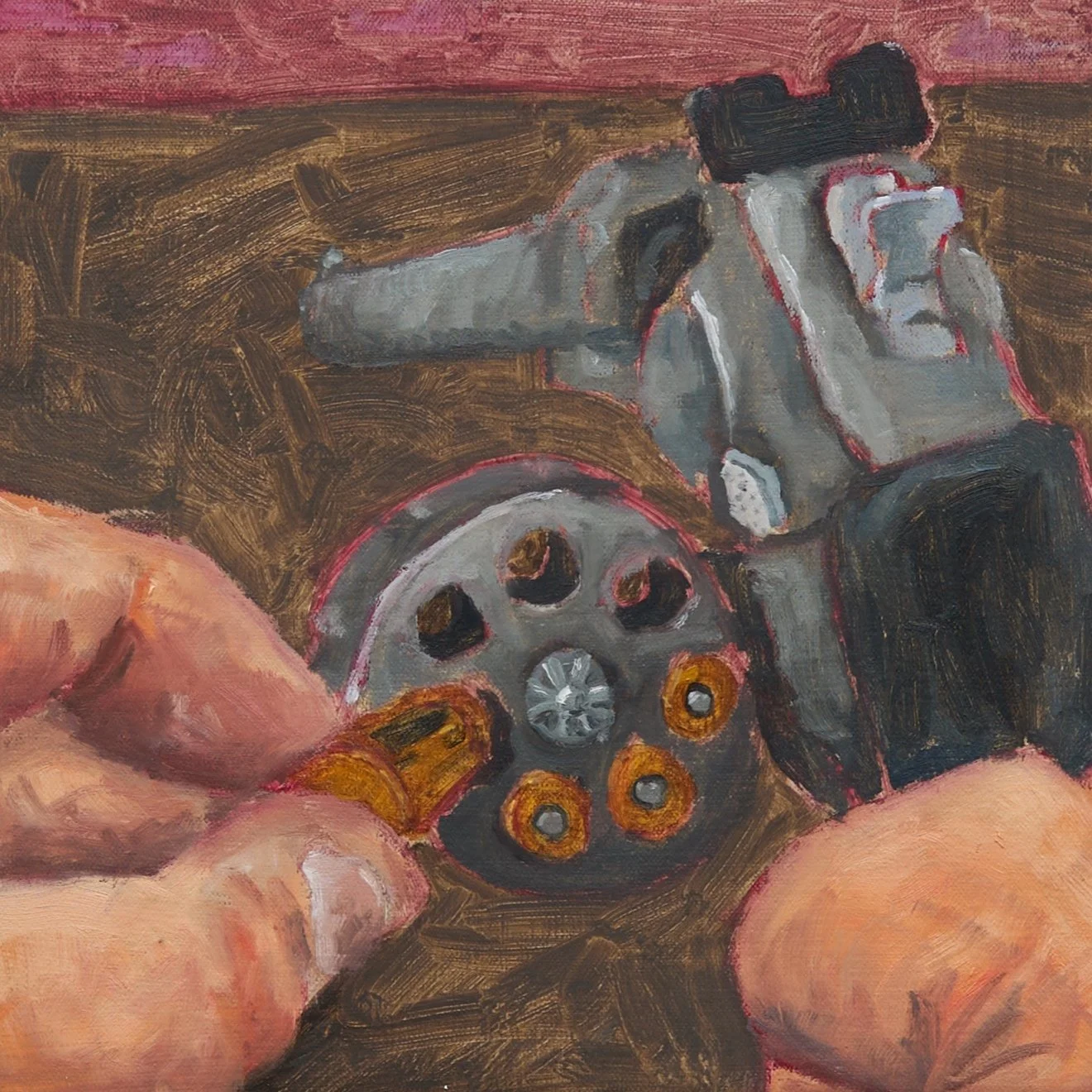
(b. 1997, Dallas TX) paintings betray a concern with narrative. However, this is a conflation of his interests in imagery and tension. Stories are built around tension, and Tignor uses this as the building material in his paintings. Tignor's paintings ask viewers to linger with the strangeness of what's before them and question the role of their viewership through images that integrate themes like violence and precarity. Tignor is currently undertaking a Master’s in Painting at the Royal College of Art.

-
(b.1992, United Kingdom) lives and works Brighton, England. His diverse practice rooted in drawing, painting explores image making, writing, performance, and land art. He has exhibited his work in Europe and the UK and has self-published three books. Winder-Lind’s work and research is tied to landscape and witnessing natural wild cycles, both in themselves and elsewhere. The nature of this research has naturally led the artist out into the fields, moors and coastline of England. The artist embody this landscape as an extension of themselves. Winder-Lind has had solo exhibitions at The Fayre, Sennen (2024), Troze Gallery, Penzance (2023), The Bookend, Brighton (2022), and the Fishing Quarter Museum, Brighton (2020).