


LOCATION: THE BOTTLE FACTORY
25 APRIL - 7 JUNE
Open Thursday - Saturday, 12noon - 5pm
Who wins if everyone is playing a different game?
Some sprint on treadmills that never move, others climb invisible ladders with broken rungs. The arena is uneven, the rules unwritten, and the scoreboard flickers with false promises. WORKOUT is an exhibition that breaks a sweat over the big stuff: our cultural obsession with fitness, body image, and the uneasy balance between discipline and desire. But beyond the visible exertion, it asks a more fundamental question — not just how we strive, but why we feel the need to measure at all.
For decades, social critics have argued that the quest for physical perfection often mirrors broader societal pressures. Susan Bordo observed that the slender, toned body — especially the female body — has become a text on which culture writes its ideals. Dieting and punishing workout routines, she argued, are less about “health” as personal choice and more about cultural coercion. In this light, thinness and fitness are not simply personal goals — they’re expectations enforced by a gaze that is both media-saturated and male-dominated.
Michel Foucault similarly explored how power inscribes itself on the body, creating what he called “docile bodies”: trained, monitored, and idealised forms shaped to fit normative standards. In the gym, as in society, we internalise this surveillance — tracking our worth in calories burned and reps completed, always under the imagined eye of others. The artists in WORKOUT confront these pressures directly, rendering the invisible weight of expectation tangible.
ARTISTS:
Vincent Arnold
Michael Chance
Ladina Clement
Marc-Aurèle Debut
Rosie Gibbens
Alex Gilmour
Guy Haddon Grant
Abi Hampsey
Lucile Haefflinger
El(ena) Hoskyns-Abrahall
Christian Jankowski
Mark Jackson
Kieran Leach
Gabriela Pelczarska
Michael Petry
Rosie McGinn
Moussa David Saleh
Helena Samarasinghe
Ke Zhang


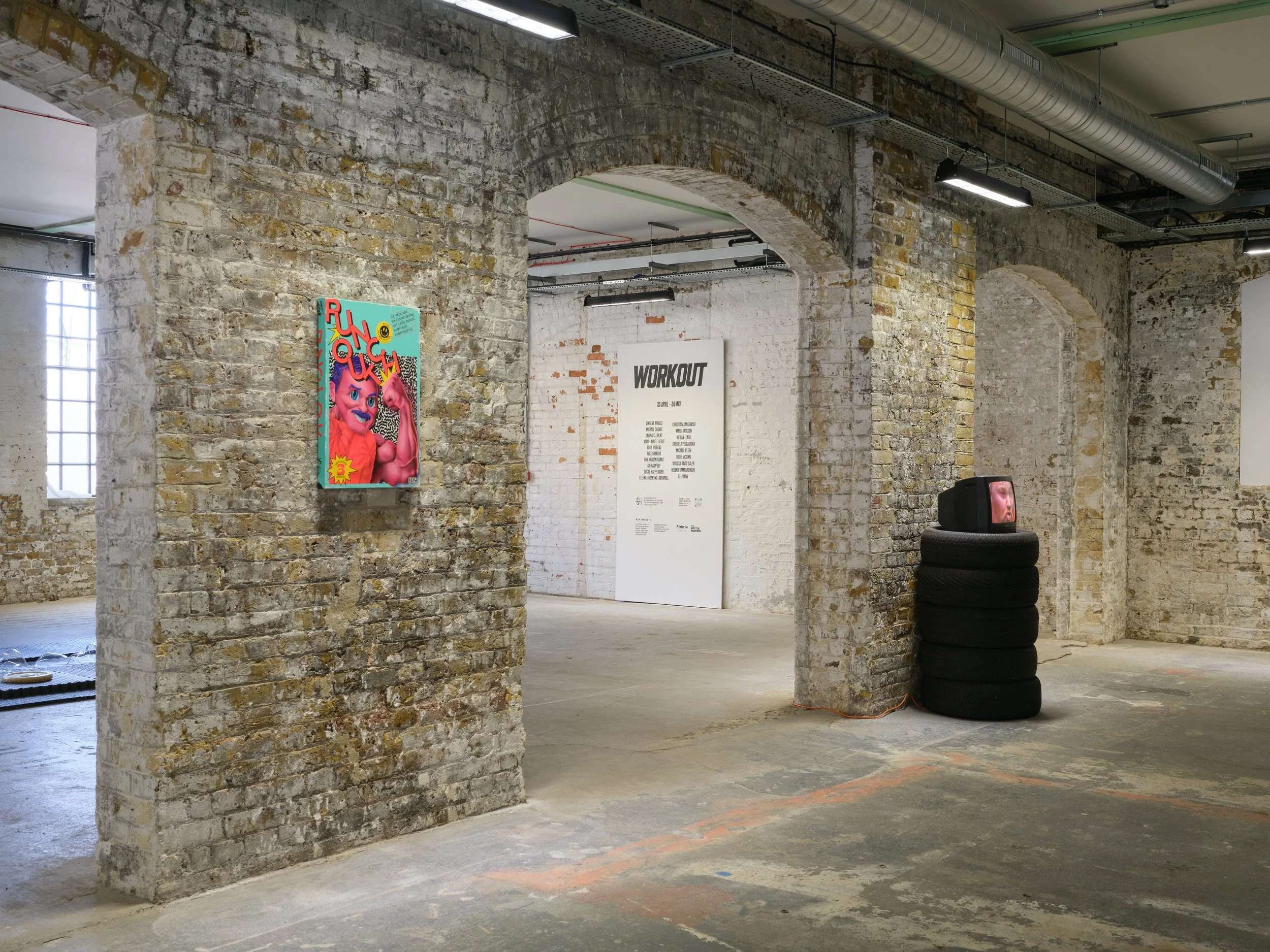


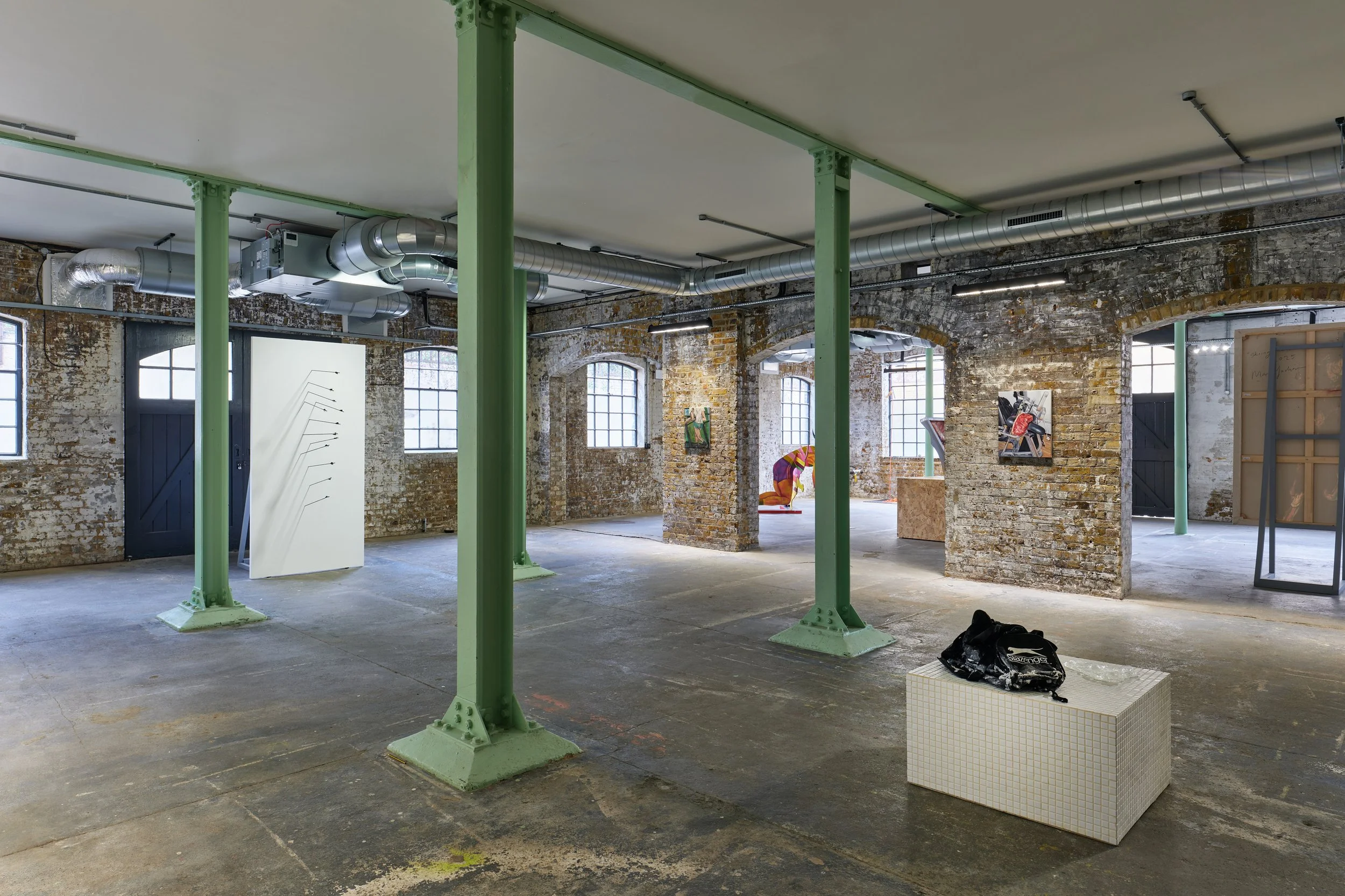


Vincent Arnold’s vivid paintings critique our obsession with branded bodies and consumerism, flattening pictorial space like a digital interface — compressed, transactional, impersonal. Helena Samarasinghe reimagines brown female athletes through the lens of resilience and resistance. Her large-scale works push back against colonial ideals of passivity, using bold gestures and materiality to reclaim power and motion.
Ladina Clément constructs anthropomorphic gym-like props that loll and slump — equipment that refuses to perform. These works evoke exhaustion and absurdity, highlighting the performative strain of perfection. Rosie Gibbens’ The New Me (advert) (2022), a wearable sculpture parodying a domestic cleaning product, transforms the body into a stylishly efficient machine. The piece satirises the pressure to optimise both self and home under the guise of empowerment.
Our fixation on athletic achievement and idealised bodies isn’t new. In Ancient Greece, the Olympics were as much sacred ritual as sport — strength as tribute to the gods. George Orwell famously called international sport “war minus the shooting”: symbolic combat charged with pride, passion, and spectacle. That collision of ritual and rivalry still echoes today.
Christian Jankowski’s Hooping Guggenheim (2025), premiering in this exhibition, collapses the boundary between sport and spectacle. In a choreographed performance, dancers twirl hula-hoops around the Guggenheim Museum, turning a bastion of high culture into a playground of physical absurdity. Rosie McGinn’s World’s Strongest Man (2018) loops footage of televised strength contests, reimagining peak fitness as a laborious, tragicomic performance — repetitive, excessive, and staged for constant consumption.
In the age of Apple Watches, Fitbits, Whoop, Garmin, and Peloton, the workout has become data-rich and increasingly disembodied. Heart rates, sleep cycles, and step counts blur the boundary between body and machine. Donna Haraway’s cyborg — part human, part hardware — lingers throughout the exhibition. Gibbens’ new work on paper Workout (2025) captures this hybrid absurdity, fusing flesh and gadget in a satirical, lo-fi vision of self-enhancement.
Gabriela Pelczarska’s sculptures destabilise our expectations of weight and motion, teasing the line between control and collapse. Ke Zhang’s installations invite viewers to navigate bodily through space, mapping how we move within — and resist — systems. These works reveal how tools used to shape our bodies increasingly shape our identities.
Judith Butler wrote that identity is performative: we become who we are by doing. Several artists in WORKOUT stage these performances — of self, of gender, of discipline. Marc-Aurèle Debut explores queer embodiment and vulnerability through installations that echo medical and psychological forms. His work presents transformation as both bodily and symbolic. El(ena) Hoskyns-Abrahall leans into the surreal and abject, confronting dysphoria with a sculptural language of humour and grit.
Transformation is a thread that also runs through the paintings of Alex Gilmour and Abigail Hampsey. Gilmour reimagines masculinity through memory and quiet observation, while Hampsey reflects on grief, endurance, and the shifting landscape of rural identity. These works suggest that transformation isn’t merely physical — it’s emotional, existential, and ongoing.
Kieran Leach’s Burnout (2025) captures this existential tension with biting humour. Two tyres in Adidas tracksuits sit mid-skid, smoke curling upward. Is it a portrait of generational burnout: a desperate bid to accelerate, to outpace peers and predecessors, only to find oneself stuck, wheels spinning. Known for abstracting the mundane, Leach here renders stasis both comic and crushing.
Mark Jackson’s skiing with louis (2025) offers similarly sharp commentary. A skier speeds downhill — they look ruthless, aggressive, with a strange apparition floating in front of them. What should be a scene of pleasure in motion, becomes one fraught and anxious. In an era of global crisis, even leisure becomes a performance of detachment, a denial framed in movement.
Michael Chance’s Twice Finalist (2024) zeroes in on the mental game of sport — in this case, tennis. Two players face off in an endless match, evoking the psychological wear of creative labour. In a world where artists are often shortlisted but rarely awarded, Twice Finalist mirrors a cycle of effort and recognition without resolution — a portrait of the artistic grind, where success is measured in CV lines rather than medals.
WORKOUT is both mirror and window. It reflects our shared yearning for better bodies, clearer goals, and transcendence — whilst offering glimpses of resistance, satire, and joy. Featuring 19 artists across diverse practices, it expands our understanding of the body as a site of power, vulnerability, performance, and play.
In the end, the exhibition reveals a deeper truth about the art world itself: artists, like athletes, are often cast as competitors. But there is no finish line — and maybe there shouldn’t be. Art prizes, once seen as markers of excellence, now increasingly feel arbitrary. After all, how can you choose a winner when everyone is playing a different sport, with different tools, histories, and rules?
THE ARTISTS:

-
VINCENT ARNOLD
Vincent Arnold (b. 1986, Quebec, Canada) received his BFA in Graphic Design from the University of Quebec in Montreal in 2012. Since then, Arnold has established himself internationally with his distinctive figurative approach, notably through his first solo show, «Hey Bro!», which took place in late 2022 at Lorin Gallery, Hollywood, Los Angeles.His art serves as a mirror that reveals, with cynicism and dark humor, individual powerlessness in the face of current societal challenges and the contradictions of our time. Seeking to evoke our digital identities, Arnold abolishes conventional depth and perspective by accentuating the flat aspect of his works, where vivid colors, smooth gradients and cast shadows that ignore volumes are reminiscent of screens and digital interfaces. In the manner of digital overexposure, Arnold’s paintings accumulate logos and branded objects to critique our obsession with consumption.

-
Michael Chance is a painter based in London, roaming around on a narrowboat and working in his studio in Bow. He studied Popular Music at Liverpool University and spent a few years playing in bands, designing posters, t-shirts and album covers in Manchester before moving to London in 2012 to study on the post-graduate programme at the Royal Drawing School.
Between 2014-18 he co-founded and ran Mercer Chance Gallery in Hoxton, showing emerging artists with a focus on drawing and painting. Since then he has dedicated himself to working in the studio, with some teaching on the side. Although Michael is primarily committed to painting, he is passionate about sculpture and makes 3D works in a kind of dialectical conversation. He also makes music and writes poetry, which inform and inspire his visual practice.

-
Ladina Clément (b.1996) lives and works in London. Clément uses the medium of sculpture to create props that question normative environments and their systems of order. Clément transforms the material qualities of functional objects to the point that they become absurd, anthropomorphic, or alluring—enabling moments of theatricality and enquiry. Her sculptures are often animated through audience interaction, robotics, and movable components. Traditional techniques of casting and mould-making form the foundation of her interdisciplinary approach, while photography, video, and performance complement the sculptural practice. Her recent research explores the intersections between physical culture and sculpture through a feminine lens. Using gym equipment as sculptural motifs, she creates work that lolls, exhales, and curls up.

-
Marc-Aurèle Debut (b.1990) is a London-based French conceptual sculptor, his practice investigates the cultural and psychological complexities of sexuality, body politics and mental health, inspired by medical studies, philosophical and artistic theories. The body is a recurring theme in his work, expressing queer experiences and investigating its currency within queer communities.
Debut (b.1990, Besançon, France) lives and works in London. He holds an MA in Sculpture from the Royal College of Art, London (2020) and a BA in Fine Art from Central Saint Martins, London (2015). Between 2008 and 2011, Debut studied Medicine at UFR Santé, Medical School in Besançon, France.

-
Rosie Gibbens makes performances, videos, sculptures and photographs that feature her body. Using absurd humour, she explores the slippery overlaps between identity, labour and consumer desire. She often makes sculptures that combine household gadgets with sewn body parts. These are brought to life through low-tech chain reactions in the performances/ films. Rosie playfully blends bodies with objects to unpack and question the prospective future body as it becomes increasingly ‘optimised’ by technological augmentation. The mindset behind her work is of a nonsensical product demonstration combined with a perverse children’s TV show.
Gibbens (b.1993, London, UK) lives and works in London, UK. She holds an MA in Fine Art, specialising in Performance and a BA from Central Saint Martins, London.

-
Alexander Gilmour (b.1990, Leeds, UK) is a painter and multi-disciplinary artist, with a practice that focuses on figurative painting in the expanded field. His work interweaves memory, observation and imaginative manipulation to cross examine perspective, masculinity and his working class background. Gilmour lives and works in London. He studied MA Painting at the Royal College of Art (2024) Leeds College of Art (2010-14) and the Royal Drawing School (2016-17), and the Turps Banana Studio programme (2022-2023). He was the 2023 Darbyshire Award Winner and his resultant solo exhibition was held in July 2024.

-
Guy Haddon Grant's monochromatic sculptures and drawings lie at the boundary between abstraction and figuration.
Haddon Grant (1986), born in London, started his studies in Camberwell College of Art before moving to Florence, Italy for two years to study the renaissance masters and their techniques. He works in charcoal, candle soot, wax, plaster, steel and wood; creating enigmatic works with a narrative that informs one another.
Haddon Grant has exhibited widely in solo and group exhibitions notably the Bloomberg New Contemporaries at the ICA and the Liverpool Biennial. He has also exhibited at the British Figure at Flowers Gallery and has held two solo shows Apophenia at the Royal College of Art and Dust and Shadows at Karavil Contemporary.

-
ABIGAIL HAMPSEY
Abigail Hampsey is a working class Artist, Baker, Farm Hand and member of the Contemporary British Painting Collective (2023). Born in Lancaster (1996) She received her BA in Fine Art from Newcastle University (2019) and her MA in Painting from the Royal College of Art (2022).
Hampseys practice Is interested in the overall exploration of landscape. Landscapes of the mind, of narrative and of the world around her. Such paintings are conceived during long walks and runs into the unfolding fields and fells that surround her. Although Abigail’s practice is born out of a deep compulsion to be outdoors, her work is laced with an underlying sense of sadness and loss. Loss of our “wild” spaces, the loss of the people and places who first introduced the artist to the landscape and the loss of our overall ability to interact freely with and in “nature”. Both at a local and global level.

-
Haefflinger grew up with their hands in the dirt and the leaves, caring for the smallest specks on the floor. Lucile studied Textile and Text at the Gerrit Rietveld Academy, Amsterdam (2019) and drawing at the Royal Drawing School, London (2019-21). Lucile is now based in Woolwich where they paint and sculpt from memories and observation. They feel an urge to contain escaping memories and feelings, whilst expressing the alienation of experiencing their own body in relation to their surroundings and other non-human beings.

-
Hoskyns-Abrahall (b. 1998) is a non-binary artist born in Edinburgh, living and working in London. After graduating with a First Class Honours from Camberwell College of Art Sculpture in 2019, Elena later went on to graduate from the Royal College of Art Sculpture Programme in 2023.
Looking at the world through the lens of abjection, Elena uses this as tool for exploring their human experience. Whether it be through art objects or wearables, the bodily and the repulsive become excellent tools for exploring the dysphoric nature of the human condition.

-
Jankowski’s work often involves performative collaborations with non-art professionals, bridging contemporary art and everyday life. These interactions explore how art is popularly perceived while touching on themes like ritual, psychology, self-image, lifestyle, competition, and consumerism. Over time, Jankowski has worked with magicians, politicians, news anchors, and members of the Vatican. Each project is shaped by the participants and the cultural context in which it unfolds.
He documents these performances through media formats native to each setting—film, photography, television, and print—giving his work a distinctly accessible, populist feel. His practice reflects and critiques both the spectacle of modern society and art’s own surrender to spectacle, raising questions about its critical role.

-
Mark Jackson is an artist based in London, England. His work considers themes of subjectivity and authorship, exploring how these concepts intersect with shifts in the technological, philosophical and cultural landscape. Recent solo exhibitions include ‘psychic surface’ at Castor Gallery (2024) and ‘turtles all the way down’ at OHSH Projects (2023). In 2024, Jackson was featured in group exhibitions across New York, Los Angeles, Leipzig, London, and Burgundy. In addition to his artistic practice, Jackson teaches and writes. His recent writing projects include an interview with Richard Aldrich (2024) and an article on Rita Ackermann (2021), both for Turps Magazine

-
Kieran Leach (b. 1994) is an artist based in Manchester, UK, predominantly working in sculpture. Kieran’s work encounters elements of every day, online, and ‘art world’ cultures, which are abstracted, condensed, and often satirized. From playful sculptural forms to modified ready-mades, his work employs a strong aesthetic sensibility and commonly approaches works with a humorous or paradoxical slant. His sculptures are varied, exploring notions such as artifice, language, cartoon physics, and the absurd.

-
Gabriela Pelczarska creates contemporary sculpture with industrial materials, dismantling their intended purposes by exploring their performative qualities through abstract compositions. Her work encourages an innately humorous response - as we observe, we are left with a sense of unease and curiosity. We witness a delicate irony between our expectations of the industrial and its playful manifestation. Exploring suggestion and movement within sculpture, she unconsciously reacts to the potential collapse caused by gravity in her works.

-
Michael Petry (b. Texas, 1960) is an artist, author and Director of the Museum of Contemporary Art (MOCA) London. His diverse body of work encompasses sculpture, installation and performance art, often blurring the lines between disciplines. Drawing inspiration from mythology, religion, history and the natural world, Petry’s creations invite viewers to engage with profound existential questions.
Petry studied at Rice University, Houston (BA), London Guildhall University (MA), and has a Doctor in Arts from Middlesex University. Petry. Petry co-founded the Museum of Installation, was Guest Curator at the Kunstakademiet, Oslo, and was Curator of the Royal Academy Schools Gallery.

-
Rosie McGinn lives and works in London. McGinn’s practice explores the human tendency to chase moments of ecstasy, whether it’s winning at Bingo, scoring a goal or jumping from space. These rituals observed within the practice often explore our relationship with transcendence and extreme human achievement. Based in London, McGinn primarily works with kinetic sculpture, video and painting.
Rosie McGinn (b. 1993, Maidstone) lives and works in London. Recent Solo Exhibitions include; ART IN STORE, Balenciaga Madison Avenue, NY [2022]; Cosmic Dancer, Slugtown, Newcastle [2022]; Contemplating my Navel, Castor Gallery, London [2021]; OBLIVION, Palfrey Gallery, London [2021]; SNOB, Recent Activity, Birmingham [2019].

-
Moussa David Saleh’s (b.1984, UK) practice is underpinned by a desire to paint serious subjects in a playful, vaguely subversive manner. Sitting alongside an examination of perennial topics such as time, death and how humans (in particular men) use formality to cloak our innate ferality, he is also interested in what it means to live and experience intimacy in an age in which we have perfected the technological tools with which to shame and tear chunks out of one another.

-
Helena Samarasinghe is a British-South Asian artist working across painting, drawing, and sculpture to explore expansive representations of the brown, female self through figuration. Influenced by Kolkata’s Kalighat painting, her large-scale drawings and cut-outs reimagine these figures within contemporary sport, challenging reductive narratives of racialised docility by celebrating embodied resilience. Centring the South Asian female athlete, she depicts physicality and strength as acts of resistance, displacing passive endurance with agency and combativeness. Her labour-intensive processes—woodcutting, dynamic mark-making, and large-scale compositions—infuse the work with a visceral presence, where the figures become sites of both visible and concealed resilience, bridging interiority and form.

-
Ke Zhang(张珂)is an artist working across installation, performance, spatial design, and artist books. Ke explores the relationship between bodily movement, spatial practice, systemic constraints, and escape—bringing together the embodied experience of movement with the generative process of art-making. Their practice involves making, finding, and assembling objects, images, texts, and bodies in space. They have contributed to Coordinator and held a residency at the Pottery Workshop in Jingdezhen. Their work has been shown internationally, including at the A4 Art Museum in Chengdu, the Art Gallery of Ontario, and in exhibitions across Toronto, Montreal, and London. Ke lives and works between London and Toronto.